The Nakagin Capsules: Modular Masterpiece of Kisho Kurokawa
The Nakagin Capsules, designed by Kisho Kurokawa in 1972, embody a revolution in modular architecture. Although faced with challenges over the years, this avant-garde project continues to inspire architects worldwide. The Nakagin Capsule Tower beautifully illustrates the fusion between technology, art, and urban living.
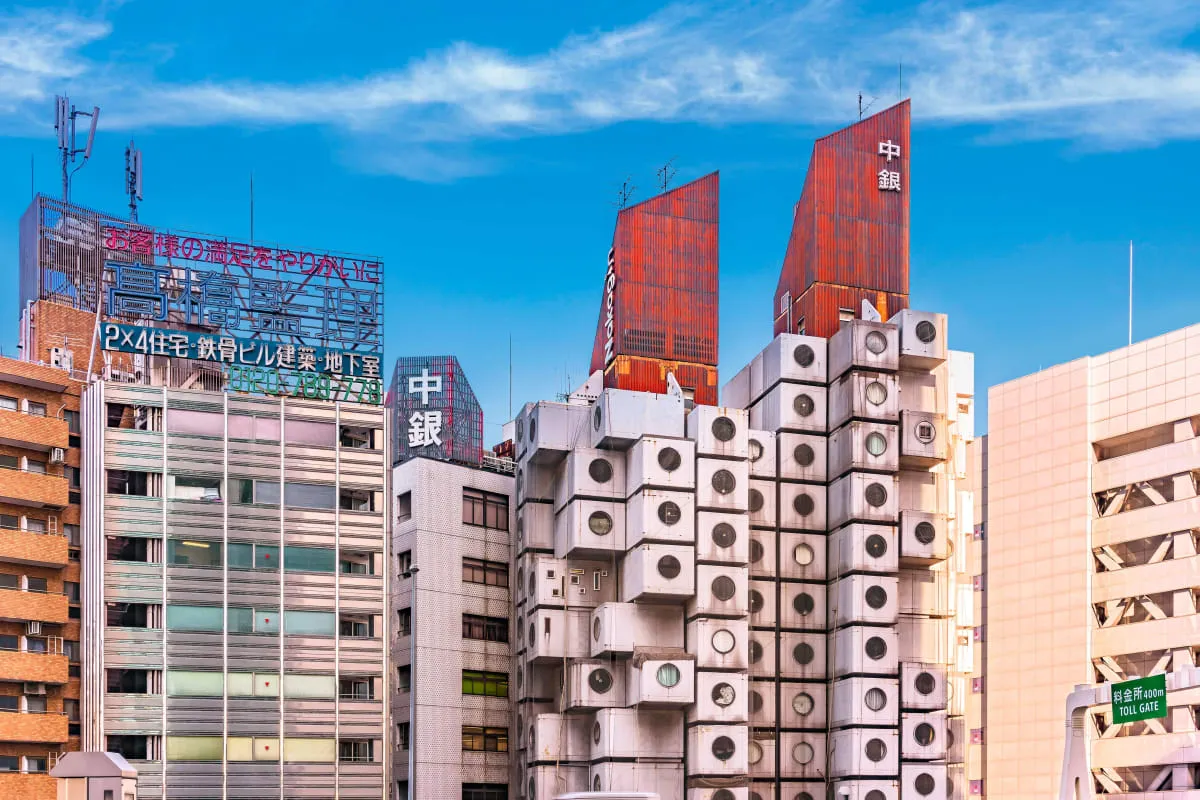
The 'Nakagin Capsules' represent a fascinating innovation in the field of modular architecture. Designed by the renowned Japanese architect Kisho Kurokawa in 1972, the Nakagin Capsule Tower is often considered a true architectural feat. Located in the Ginza district of Tokyo, this tower stands out for its radical and avant-garde approach to urban living.
Kisho Kurokawa based the design on the principles of metabolism, a Japanese architectural movement of the 1960s, to create this building. Metabolism advocated for flexible and organic architecture, capable of growing and evolving like a living organism. The Nakagin Capsule Tower is one of the most concrete manifestations of this philosophy.
The tower consists of two central concrete structures, to which 140 individual capsules are attached. Each of these capsules, prefabricated in a factory before being transported to the site, measures approximately 2.3 meters by 3.8 meters and has a depth of 2.1 meters. These modular units were intended to serve as living spaces or offices for traveling businessmen, meeting the needs for flexibility and mobility of modern urban life.
Each capsule is equipped with a large circular window and essential amenities. The compact living spaces were designed to be self-sufficient, integrating a prefabricated bathroom, a bed, a desk, and storage cabinets. Although the capsules are small, the intelligent interior arrangement allows for optimal use of the available space.
Flexibility was at the heart of Kurokawa's vision. The capsules were designed to be easily detached, replaced, or rearranged as needed, without disrupting the main structure. This modularity not only offered a response to fast-changing demographic and economic conditions but also allowed for easier maintenance. The idea was that occupants could modernize or replace their capsules without demolishing the entire building, a sustainable and ecological approach.
However, despite this innovative intent, the Nakagin Capsule Tower faced challenges over the years. The capsules were never regularly replaced as intended, partly due to the costs and logistical complexities involved. Ultimately, the building has been threatened with demolition, sparking debates over the preservation of this unique architectural heritage.
Despite these challenges, the Nakagin Capsule Tower continues to captivate architects and urban planners worldwide. Its bold design and avant-garde concept have paved the way for many explorations in modular and sustainable architecture. Ultimately, Kisho Kurokawa's project remains a brilliant illustration of the fusion between technology, art, and urban living, offering valuable lessons for the contemporary challenges of architecture and urban development.